- Projects
- Exhibitions
- Designing childhood, design museum brussels, 2026

brussels
The Geometric Life
“Designing Childhood. A History of Design for Children”
from 01.04 to 20.09.26
A field of experimentation and innovation, children’s furniture has played a significant role in the history of 20th-century design. It embodies the ambitions, social transformations and technological advances of its time. Children’s furniture is defined by its playful dimension — furniture as play — and by its versatility, while also reflecting the evolving place of the child within the family and society. Gradually recognised as a person in their own right, the child ceased to be seen as a “small adult” and began to occupy a specific place in the home, in society and in the design market.
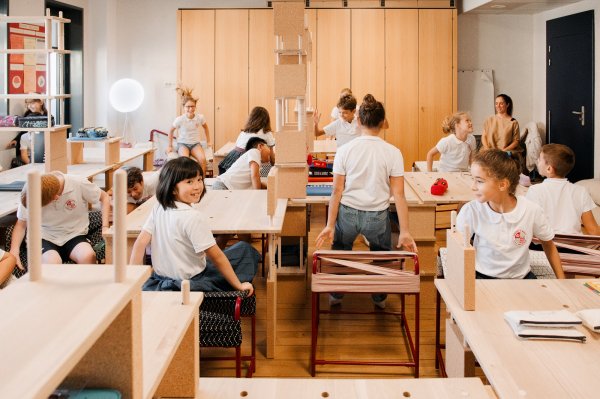
smarin presents a light, durable domestic installation system that gives priority to comfort:
La vie géométrique, made of cork, oak and wool.
It is a construction system — without nails or screws — composed of highly structuring elements such as partitions, bars or sofas: a set of blocks made from pure materials, with carefully studied sizes and densities, handcrafted within the framework of healthy production.
Together, these elements form the nomenclature of a utopian hypothesis for living — one in which geometry is capable of softness and flexibility.
What sparked your studio’s interest in designing for children?
At smarin, we do not approach design through strict categories, but through situations, publics and ways of living together. Our interest in designing for children came quite naturally through projects related to education, public space and collective use.
A key moment was an invitation from Centre Pompidou-Metz, during the exhibition L’Art d’Apprendre, to imagine a classroom inside the museum. Rather than simply designing furniture for children, we asked ourselves what design could contribute to a learning environment: not pedagogy itself, which belongs to teachers, but the physical and material conditions that shape attention, movement, participation and confidence.
This led us to develop systems that allow users to act on space directly: to build, rearrange, transform and understand it together. In that sense, children were not a “target market” for us, but a particularly inspiring public, because they engage very directly with the agency of objects, with imagination, and with the collective negotiation of space.
What material and functional qualities do you think are most important to consider when designing for young users?
Materially, the priority is very clear: healthy, honest, low-impact materials. We care a lot about avoiding invisible pollution in interiors. Today, many indoor environments are saturated with synthetic compounds and toxic emissions, and children are especially exposed to them. So for us, materials must be non-toxic, durable, repairable, and as little transformed as possible.
Functionally, we are interested in objects that do not overdetermine behaviour. We try to create systems rather than fixed pieces — elements that can be assembled, moved, interpreted and reinvented. We draw inspiration from construction games, from open grammars, from situations where the user can discover how space works by acting on it.
For young users, this is very important: furniture should not only support the body, it should also support autonomy, imagination and a sense of collective agency. A good object is not only comfortable or safe; it helps children understand that space is something they can shape together.
Why do you believe consumers are willing to invest more than ever in design pieces for children?
First, because the space of childhood is no longer seen as secondary. More and more people understand that the environments offered to children are formative: they shape the body, attention, habits, relationships and even values. So investing in children’s furniture is not only about decoration; it is about everyday conditions of life.
At the same time, I think many consumers are becoming more attentive to what a price actually reflects. If an object costs more, ideally it should be because it embodies better production conditions, healthier materials, greater durability, and a more responsible relation to resources. Of course, affordability remains a crucial issue, and not everyone can invest in such pieces. But when people do make that choice, they increasingly want fewer, better objects — objects that last, that can evolve, and that make sense ethically as well as functionally.
In that respect, children’s design is also part of a broader cultural shift: from disposable goods toward pieces that carry care, longevity and a certain vision of the world we want to build.
How do you see the design of children’s furniture evolving in the future?
It is always difficult to predict the future, but we can work toward the future we would like to see. For us, children’s furniture should evolve toward healthier materials, lighter production footprints, and more open-ended forms of use.
We believe the future lies less in hyper-specialised objects and more in adaptable systems: furniture that can accompany different ages, different activities, and different collective situations; furniture that can be repaired, reconfigured, stored, transmitted or locally produced. In other words, pieces that are less fixed and more alive.
We also hope children’s design will continue to move beyond pure consumption and toward real cultural and social value. The challenge is not only to make beautiful furniture for children, but to create environments that support imagination, bodily awareness, cooperation and confidence. As a studio, we try to contribute to this by looking for affordable ways to produce genuinely low-impact furniture, under good production conditions, while preserving a strong dimension of play and imaginability.